
Starting your own construction business is kind of like standing on top of a cliff. It’s exhilarating and terrifying at the same time.
You think about permits, and clients, and budgets and your brain probably starts swimming around.
But what’s really going to kill you in the beginning is being caught unprepared. Showing up to your worksite with the right tools and equipment means looking professional, working efficiently, and preventing expensive mistakes.
You’re going to need gear whether you’re building houses, specializing in renovations or flipping condos. We want you to work smarter, safer and feel more confident doing it!
Let’s roll up those sleeves and get into it.
Start With the Basics: Hand Tools That Do the Heavy Lifting
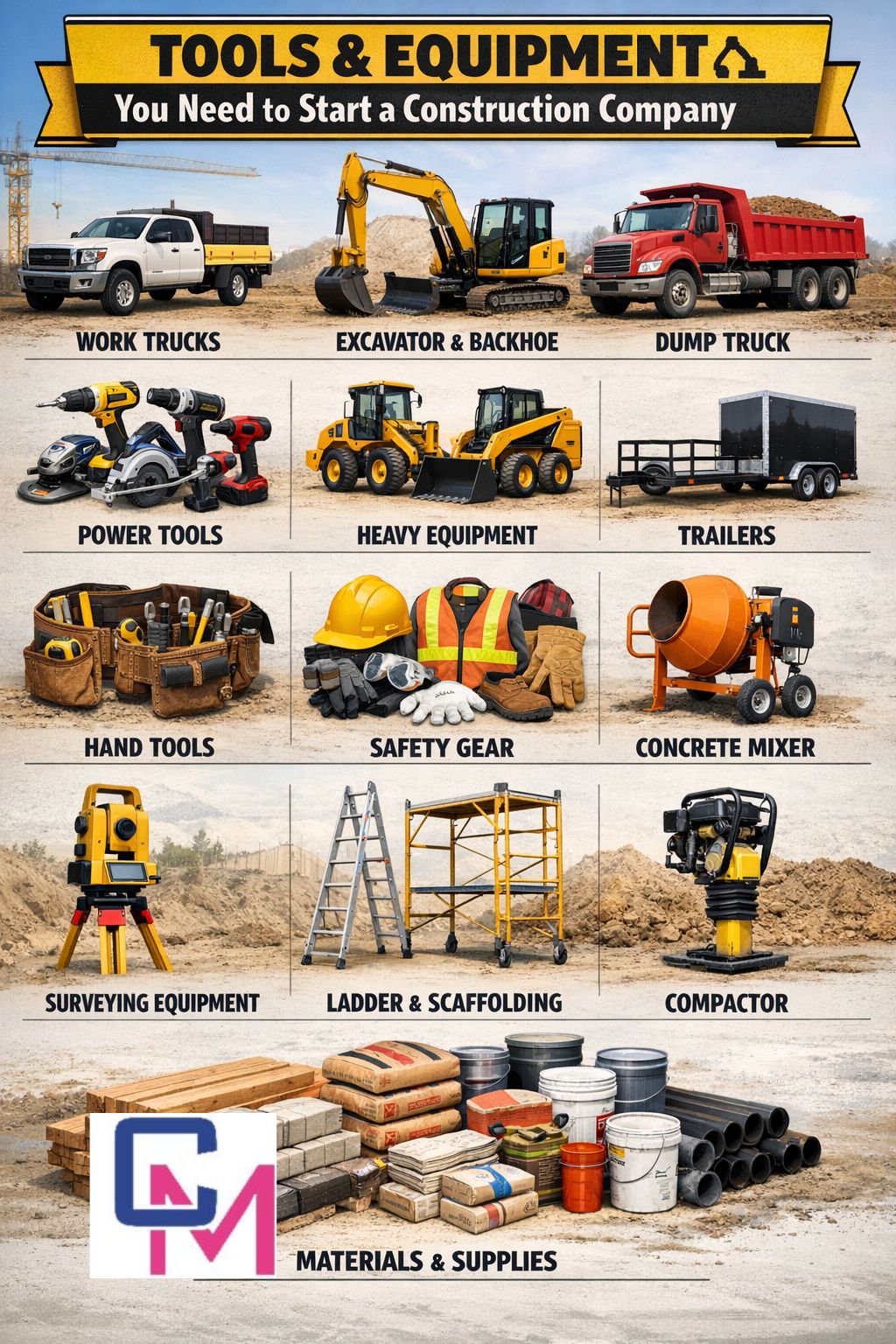
Before bulldozers and nail guns there were hand tools. Some may consider hand tools old school, but you will use them for almost every task.
Purchase a quality set. Make sure you have a hammer, tape measure, utility knife, screwdrivers, adjustable wrench, pliers, and a level. Throw in a speed square and chalk line, and you can make precise layouts. Accuracy is key. One inaccurate cut or line can become a costly error down the road.
Consider these tools your closest friends. They’ll spend a lot of time in your pocket, truck and on your tool belt. Invest in quality tools from the start. Flimsy tools will break, take you longer to finish your jobs, and let’s be honest they drive you crazy.
Keep your tools organized. Whether it’s a tool bag or rolling tool box, stay efficient and appear professional in front of customers.
Power Tools: Where Efficiency Meets Productivity
If hand tools are your skeleton crew, power tools are your studs. At bare minimum you’ll want a cordless drill/driver and impact driver. Those two will take you through almost any fastening situation. Throw in a circular saw to rip lumber, a reciprocating saw for demolition and a jigsaw for precision cuts.
As you pick up more clientele and work, a miter saw and table saw will help with bigger carpentry projects. Battery operated tools are great for startups. You won’t need generators or extension cords on small jobs.
Let me give you the best piece of advice. Faster = More Profit. If you can work quicker and cleaner you can get more jobs done. Power tools are an investment that work for you.
Safety Equipment: Because Nothing Matters More
OK, let’s get serious for a second here. Construction can be very rewarding. However, it is not without its dangers. One mistake can not only cost you time and money but your reputation as well.
Start with the basics. Hard hats, safety glasses, gloves, steel-toe boots, and high visibility vests are key. Ear protection and dust masks are equally as important, particularly when performing demolition or cutting work.
When working at heights, fall protection such as harnesses and guard systems can mean the difference between life and death.
Equipment also shows your clients and employees that you care about your operation. When your employees feel safe, they can work safer and with more confidence.
Measuring and Layout Tools: Precision Builds Trust
Measure twice, cut once. And make sure you have good measuring and layout tools.
In addition to tape measures and carpenters levels. Pick up a laser level or rotary laser. They will allow you to shoot lines around rooms quickly and easily keeping your framing, drywall and flooring perfectly aligned every time.
Pick up a moisture meter too. If you plan on doing any kind of renovation work, you never know when you may run into hidden water issues. Since they can lead to big money callbacks if you don’t catch them.
When your work looks like it was done perfectly straight and professional, your clients will notice. Attention to detail leads to trust. And trust leads to referrals.
Material Handling Equipment: Save Your Back (and Your Time)
At the start of your business, there may come times when you think, “I’ll just pick it up myself.” This mentality may serve you for a time, but only so far.
Wheelbarrows, dollies and material carts are basic handling equipment to move heavy things safely. Ladders and step platforms are necessary for most residential work, while scaffolding is needed for bigger jobs.
When lifting heavy bags of concrete or stacks of lumber repeatedly, invest in small mechanized assistance or portable hoists. You can’t build a business when you’re injured. Good handling means jobs stay on schedule and your employees stay healthy.
Heavy Equipment: Rent Before You Buy
Here’s a big way that new construction businesses lose money: purchasing large equipment too early.
Excavators, skid steers, mini-loaders are great tools. But they’re expensive to buy and maintain. Renting is almost always your best option when you first start. You’ll keep overhead low and you can get exactly what you need for each job.
Once you have steady work and understand what equipment you regularly use. You should consider purchasing some equipment.
Your biggest asset when starting a business is cash flow. Guard it zealously.
Workshop Equipment: Where Custom Work Happens
Eventually you might find yourself wanting or needing a small workshop or fabrication area as your business expands. This is particularly handy if you deal with custom metal parts, modifying hardware, or odd repairs.
For these applications a machine such as a metal lathe can be a lifesaver. They give you the ability to cut and fine tune metal to your specifications. Send fewer projects out to be fabricated and get more done internally.
If you don’t need one immediately you can always plan for one in the future.
Vehicles and Storage: Your Mobile Headquarters
Your truck or van is more than just a method of transportation. It’s also your mobile office, storage facility, and branding opportunity all wrapped into one.
Pick a sturdy vehicle with plenty of room for tools, building materials, first-aid kits and whatever else you need for the job. Install shelves, storage bins and lockable cabinets to help you stay organized and ensure that everything has its place.
Your vehicle’s appearance is important, too. A clean vehicle with tasteful graphics will make your business appear more established and professional. When you’re starting from nothing, first impressions are vital.
Digital Tools: The Modern Contractor’s Secret Weapon
Construction used to mean hammers and nails. Now there are digital tools for staying organized, communicating clearly, and managing jobs.
Project management apps make sure everyone is on schedule. Estimating software helps you calculate prices. Cloud storage allows you to access plans and photos from anywhere. And basic invoicing programs can streamline your cash flow and appear more professional.
Use technology to be your secret weapon. Technology will take care of paperwork while you do the work.
Start Smart, Grow Strong
Want the short version? Don’t try to have everything day one. Focus on the basics. Hand tools. Dependable power tools. Safety equipment. Rent heavy equipment until you have enough jobs to purchase it. Expand your workshop and collection of tools as your jobs become larger.
Starting your own construction business takes knowledge, planning, and elbow grease. There will be days where you work crazy hours, things that you didn’t plan will come up, and you will question your decisions. But if you have the right tools in your toolbox and a game plan prepared, you can take on any project that comes your way.
Because when all is said and done, construction isn’t just about pouring concrete and building houses.
You’re building a reputation. A career. A life for yourself.
It all starts with having the right tools.
Investment Hacks Discommercified: Practical Strategies Guide
About the Author
Waqar Ashraf is the Founder and Editor of Closer Magazine. He publishes informative and engaging content covering lifestyle, entertainment, wellness, trending topics, and digital culture.
Through Closer Magazine, Waqar aims to provide accurate, reader-friendly, and valuable information for audiences worldwide.
📧 closermagazine0@gmail.com
🌐 CloserMagazine.co.uk