
Walk up Sixth Avenue in Midtown and you can feel the city shifting as you move block by block. The crowds thicken, the storefronts sharpen, and the skyline becomes less about one famous spire and more about a rhythm of towers working together.
In that rhythm, 1221 avenue of the americas is easy to miss at first glance and hard to forget once you notice it. It does not rely on ornament or drama. It relies on presence: a clean, powerful slab of International Style architecture that belongs to Rockefeller Center’s later era, when New York’s corporate life needed more space, more efficiency, and a more modern expression.
This building’s story is not just about height or square footage. It is about how Rockefeller Center expanded, how office culture evolved, and how a mid-century idea of “modern” is being updated for today’s city.
| Property Name | 1221 Avenue of the Americas |
|---|---|
| Also Known As | McGraw-Hill Building |
| Location | Sixth Avenue between West 48th & 49th Streets, Midtown Manhattan, New York City |
| Complex | Rockefeller Center |
| Architect | Wallace Harrison (Harrison & Abramovitz) |
| Architectural Style | International Style |
| Completion Year | 1973 |
| Floors | 51 |
| Height | Approx. 674 feet (205 m) |
| Building Type | Commercial Office Tower |
| Notable Tenants | Deloitte, SiriusXM, and other major corporate firms |
| Owner / Developer | Rockefeller Group |
| Sustainability | LEED for Existing Buildings (LEED-EB) Certified |
Rockefeller Center’s Second Act
Most people connect Rockefeller Center with its early, iconic identity: the 1930s project that turned a difficult real-estate moment into a bold, coordinated complex of public space and commercial ambition.
But Rockefeller Center did not freeze in time. By the 1960s, Midtown was under pressure again, just in a different way. The question was no longer how to build confidence during a depression-era economy. The question became how to keep Rockefeller Center competitive as modern office towers rose across Manhattan.
That is where the later expansion comes in. Plans for new towers along Sixth Avenue were drawn in the early 1960s by Wallace Harrison, a key architect associated with Rockefeller Center and a leading figure in the firm Harrison & Abramovitz. This expansion produced the trio commonly called the “XYZ Buildings,” a nickname tied to their relative heights.
In simple terms, Rockefeller Center extended its own logic north and west: large-scale, coordinated development, integrated with transit and public circulation, but expressed in a cleaner, more pared-back architectural language than the earlier Art Deco core.
The Birth of the XYZ Buildings
The XYZ set was designed as a family of towers: similar in feel, different in scale, and aligned along Sixth Avenue so they read as a coordinated extension of the Rockefeller Center presence.
1221 avenue of the americas became the “Y” building in that lineup. It was designed in the International Style, with a straightforward cuboid massing and a façade that emphasizes verticality through alternating bands of glass and red granite piers. It stands 51 stories, with a roof height around 674 feet, and it was developed as a major office building within this expanded Rockefeller Center footprint.
This matters because the building wasn’t intended to be a lone landmark. It was intended to be part of an urban system: a linked set of modern office towers that could attract top-tier tenants and keep Rockefeller Center commercially relevant for decades.
Design That Chose Restraint
There is a reason International Style towers still photograph well. Their logic is simple, and their confidence comes from proportion, repetition, and material discipline rather than decoration.
With 1221 avenue of the americas, the restraint is the point. The tower’s surface is described as largely undecorated, using strong vertical elements and glass stripes to create a clean, corporate texture.
That restraint also reflects the era’s workplace ideals. Mid-century corporate architecture favored order, clarity, and efficiency. A tower like this communicated stability: a serious building for serious institutions, at a time when Midtown’s identity was increasingly shaped by global business.
A Rockefeller Address That Works Like a Network
Location is not just a pin on a map in Midtown Manhattan. It is access, circulation, and what a building connects you to without you having to think about it.
1221 avenue of the americas sits on Sixth Avenue between West 48th and West 49th Streets, right where Rockefeller Center’s gravitational pull meets the everyday flow of the Theater District and Midtown commuting patterns. That stretch of Sixth Avenue is also where Rockefeller Center’s later expansion feels most tangible: you can read the complex not as one plaza and one famous building, but as a neighborhood-scale system.
Over time, the building’s value has been reinforced by what it can offer beyond its walls: proximity to multiple subway lines, walkability to major Midtown destinations, and integration with Rockefeller Center’s broader ecosystem of offices, retail, and public space.
The McGraw-Hill Era and What It Signaled
The building has been known historically as the McGraw-Hill Building, reflecting the corporate presence tied to the address for many years. That name is part of the building’s identity because it signals what the tower was built to do: anchor a large-scale tenant with the space and infrastructure a major publisher or financial brand required in the late 20th century.
Even after tenants evolve, an address like this retains a certain “corporate gravity.” It is not a boutique building. It is a platform for organizations that need scale, security, reliable building systems, and a Midtown address that helps with recruiting and client perception.
The Workplace Keeps Changing, So the Building Had To
A common misconception about office towers is that they are “finished” at completion. In reality, many office buildings live through multiple lives. The structure may remain, but the experience changes: entrances are rethought, lobbies are rebuilt, plazas are redesigned, and sustainability standards rise.
In the 2010s, the building underwent major work that focused on how people actually enter, move through, and experience the property. Rockefeller Group describes a multi-year revitalization beginning in the mid-2010s that helped drive significant leasing activity and repositioned the building for contemporary expectations.
Modern tenants care about what happens before the elevator ride. They notice security flow, daylight in the lobby, and whether the ground floor feels welcoming or defensive. They also care about amenities nearby and whether the building fits the “I can imagine my day here” test.
A Plaza With a Long Memory
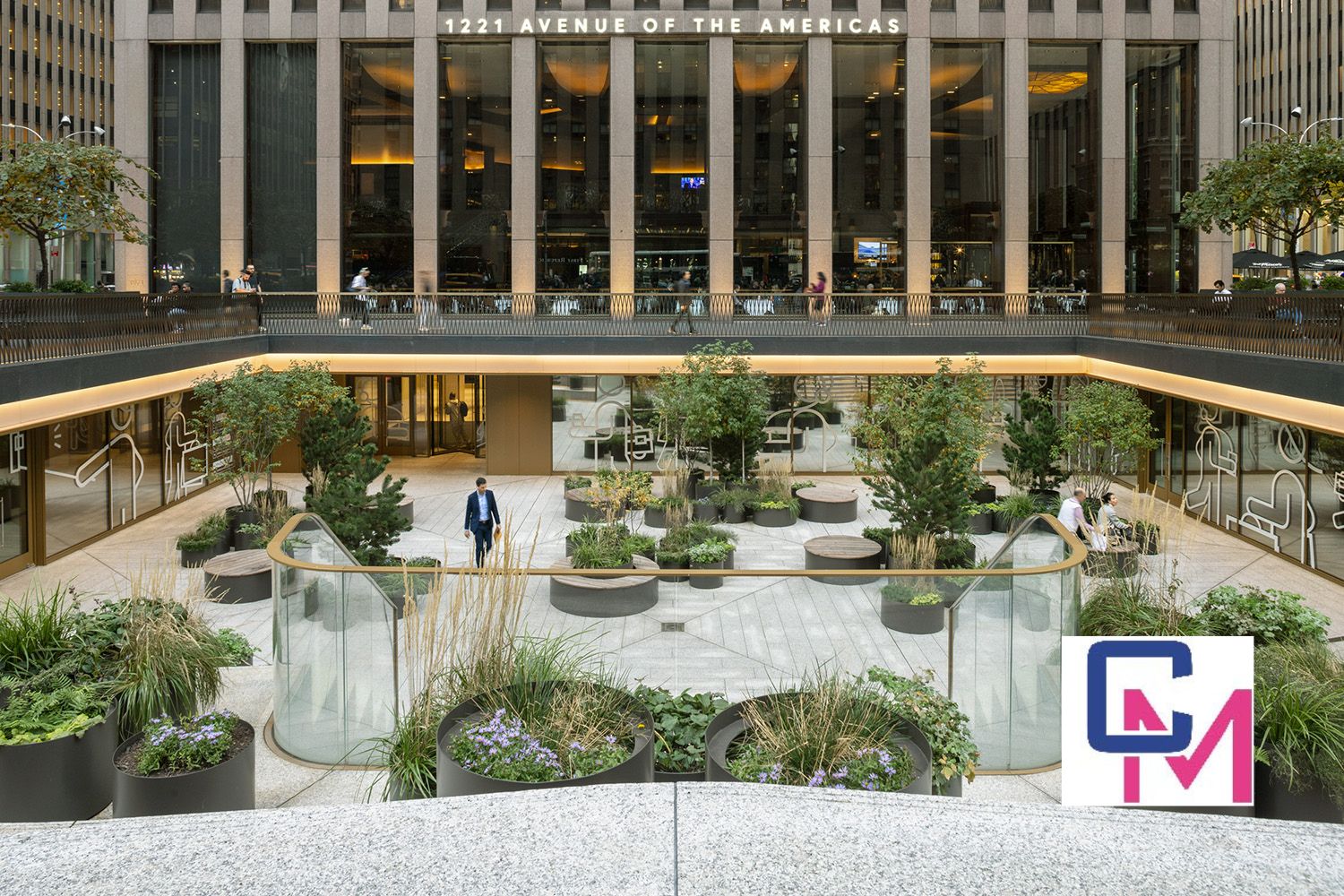
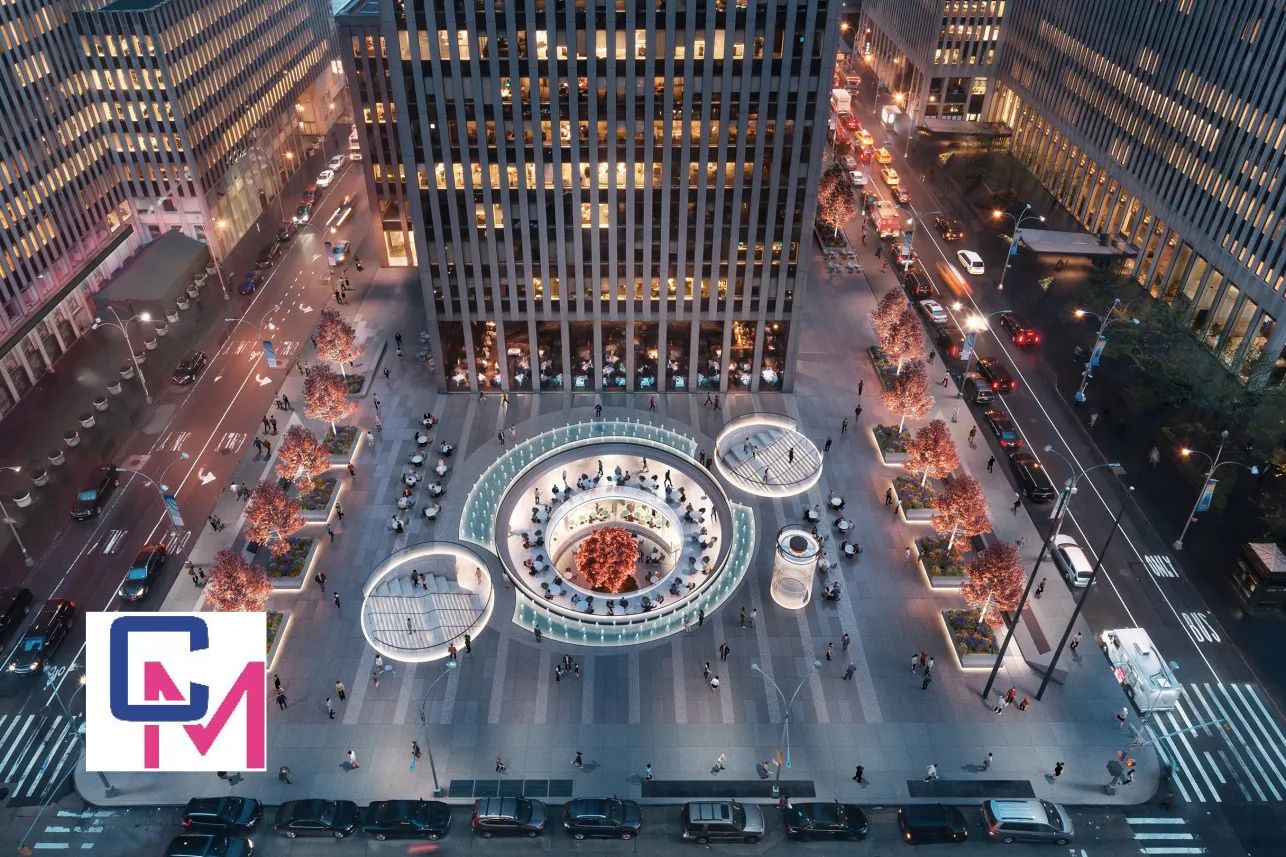
One of the most distinctive parts of the property has been its plaza condition along Sixth Avenue, historically recognized for a sunken public space that stood out in a corridor of street-level sidewalks.
Architectural Digest reported that the plaza between West 48th and West 49th Streets originally opened in 1969, and it became known for its sunken design and a triangular sculpture. In 2017, a major redesign was announced, led by the Italian design firm Citterio-Viel & Partners, aimed at transforming the space and adding substantial retail area below grade.
What’s important here is not just the aesthetics. It is the underlying urban question: how do you make privately owned public space feel genuinely useful and inviting, instead of feeling like leftover real estate?
The 2023 Transformation and the Push for Better Public Space
By 2023, Rockefeller Group described completing a roughly $50 million renovation of the Sixth Avenue plaza, redesigned by Antonio Citterio Patricia Viel, with a goal of making the space more inviting throughout the day.
Bloomberg’s CityLab also highlighted the renovation as a meaningful example of how privately owned public spaces can be improved, noting how upgrades and better connections can pull real users into spaces that previously felt underused.
This is a key point for your readers: buildings like 1221 avenue of the americas are no longer judged only by what happens on the 30th floor. They are judged by what they contribute at street level. In a city as crowded as New York, the ground plane is not optional. It is part of the building’s public reputation.
Sustainability as a Reputation, Not a Checkbox
Sustainability is one of the most visible ways office buildings compete today. Certifications matter because they signal ongoing investment and operational discipline.
In 2009, Rockefeller Group announced that the building achieved LEED for Existing Buildings (LEED-EB) certification, a milestone that positioned the property within the sustainability conversation for large Midtown office towers.
Even if readers do not follow the details of certification systems, they understand the cultural message: this is a building trying to stay current. In a market where tenants compare options quickly, “updated and efficient” is part of the pitch, whether the tenant is a legacy firm or a new-media company.
The Tenant Mix Tells a New York Story
One reason this tower remains relevant is that it fits a wide range of major tenants. Over time, the building has housed large professional services and corporate tenants, including Deloitte’s New York presence and SiriusXM’s headquarters and broadcast facilities, among others.
That mix is a snapshot of Midtown’s economic reality. New York’s commercial core is not one industry. It is a blend of finance, media, law, consulting, and tech-adjacent businesses that want proximity to clients and talent.
When a building can serve that blend, it stays in the conversation, even as newer developments try to lure tenants with brand-new systems and flashy amenity decks.
Ownership, Value, and Why This Building Keeps Getting Attention
A tower like this is not only a workplace, it is also a long-term asset. The building’s investment story has made headlines, including a widely reported deal in which a large stake sale helped set a multi-billion-dollar valuation for the property.
That kind of attention reinforces the building’s status in the commercial market: it is seen as stable, valuable, and worth reinvesting in. When ownership invests in lobbies, plazas, and long-term upgrades, it usually reflects confidence that the address will remain competitive.
What 1221 avenue of the americas Represents Today
Today, the building sits at an interesting intersection.
On one side, it represents a classic, disciplined vision of corporate modernism: a clear tower, strong materials, and a sense that Midtown is a machine that should run smoothly.
On the other side, it represents how that modernism is being edited for a different era. The new emphasis is on experience, public space, and the daily human details that determine whether a building feels alive or merely functional.
In the clearest sense, 1221 avenue of the americas is Rockefeller Center’s later voice: less Art Deco spectacle, more International Style confidence, and a continuing effort to keep a Midtown landmark complex responsive to the way New York actually lives and works.
Conclusion
The story of this building is not a single dramatic moment. It is a slow narrative of expansion, adaptation, and reinvention.
It began as part of Rockefeller Center’s push to remain a leader in Midtown’s office market, shaped by Wallace Harrison’s vision for the XYZ buildings and expressed through a restrained, powerful design language.
And it continues today through upgrades that recognize a simple truth: a modern office tower has to earn its place in the city every day. That means better public space, smarter operations, and a ground-floor experience that feels like New York, not like a sealed corporate island.
If you want one takeaway to underline for your readers, it’s this: 1221 avenue of the americas is not only a building in Rockefeller Center. It is a case study in how a landmark complex stays contemporary without pretending to be brand new.
The Story Behind Ronnie Foden and His Famous Family
FAQs
Where exactly is 1221 Avenue of the Americas located?
1221 Avenue of the Americas is located on Sixth Avenue between West 48th and West 49th Streets in Midtown Manhattan. It forms part of the extended Rockefeller Center complex along Sixth Avenue.
Why is 1221 Avenue of the Americas sometimes called the McGraw-Hill Building?
The building has long been associated with McGraw-Hill due to the company’s major tenancy there. Over time, the name became informally linked to the property, even as other large tenants moved in.
Who designed 1221 Avenue of the Americas?
The tower was designed by Wallace Harrison of Harrison & Abramovitz. It reflects the International Style that defined much of Midtown’s corporate architecture during the 1960s expansion period.
How tall is 1221 Avenue of the Americas?
The building rises approximately 674 feet and contains 51 stories. It is one of the three so-called “XYZ Buildings” developed as part of Rockefeller Center’s later expansion.
Has the building been renovated in recent years?
Yes. The property has undergone significant renovations, including lobby upgrades and a major redesign of the Sixth Avenue plaza. These updates were aimed at modernizing the experience for tenants and improving the surrounding public space.
About the Author
Waqar Ashraf is the Founder and Editor of Closer Magazine. He publishes informative and engaging content covering lifestyle, entertainment, wellness, trending topics, and digital culture.
Through Closer Magazine, Waqar aims to provide accurate, reader-friendly, and valuable information for audiences worldwide.
📧 closermagazine0@gmail.com
🌐 CloserMagazine.co.uk